
The Pipes That Freeze Are Not the Ones You Are Watching
Frozen pipes in a Minnesota or northern Wisconsin winter are almost always preventable, and almost all of the prevention happens in November rather than during the cold snap itself. The kitchen tap keeps running, so everything looks fine, until a line quits during the first stretch below zero.
Three places fail in Twin Ports homes. One is pipes freezing in wall cavities outside the building. Another is the rim joist above the foundation. The third is any line in an unheated crawl space, garage or porch. Those are the exposed pipes nobody checks.
Why Pipes Freeze and Why the Damage Comes Later
Water expands as it freezes. The ice plug itself rarely splits the pipe where it forms. The burst usually happens between the ice and a closed faucet, where the pressure has nowhere to go. That trapped pressure, not the ice, is why pipes burst in the winter.
So a stopped faucet is urgent. A pipe can freeze on Tuesday and flood the basement Thursday when it thaws.
Which homes are at risk comes down to three things. Wind exposure on the lake side pulls heat out of a wall faster than the thermometer suggests. A rim joist that was never insulated leaves water pipes sitting in moving cold air. Remodels that ran a supply line through an outside wall put it in the worst spot in the house.
There is no single temperature at which pipes freeze. Wind, insulation, and how long the severe cold lasts change the answer.
What You Will Need for an Afternoon of Winterizing
- Foam pipe insulation sleeves
- Expanding foam or caulk for gaps
- UL listed heat tape for problem runs
- A flashlight
- An outdoor faucet cover for each hose bib
- Rigid foam or batt for the rim joist
- A cabinet thermometer or a cheap probe
- Your water shutoff location, confirmed
Not sure where the water service enters your house? Request an estimate.
How to Prevent Frozen Pipes, Step by Step
- Disconnect and drain every garden hose. Shut the interior valve that feeds each outdoor hose bib, then open the bib to drain the line. Hoses left connected trap water in the sillcock. That is the most common burst we see in the Twin Ports.
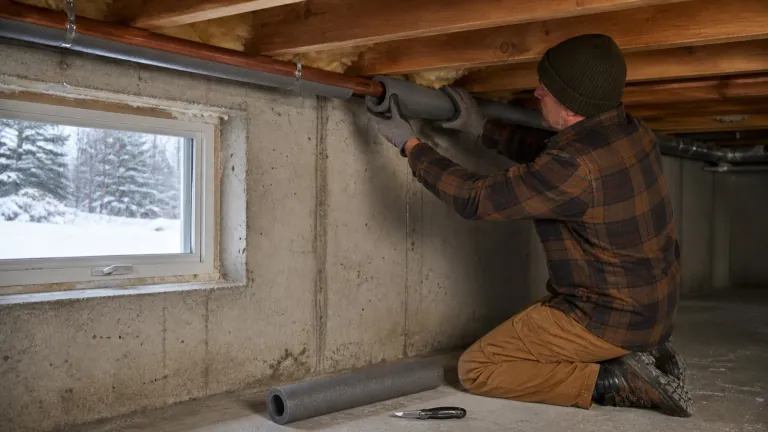
- Insulate the exposed pipes you can reach. Sleeve every run in the basement, crawl space, garage and three-season space. Watch the lines on the outside face of the building, where wind pulls heat out of the wall.
- Seal the air leaks. Foam or caulk the gaps where the water service enters the house, then insulate the rim joist itself. Cold air moving across a pipe freezes it far faster than still cold air.
- Add UL listed heat tape to the runs you cannot insulate your way out of. Follow the product’s own installation directions. Candidates include a crawl space line, a garage run to a utility sink, and a supply a remodel put in an exterior wall.
- Open the cabinet doors under sinks on exterior walls so warmer air reaches the pipes. If you close off spare rooms, leave those doors open through the cold stretch to let air circulate. Keep the thermostat steady instead of setting it back at night.
- During an actual cold snap, let a pencil-width drip run from the fixture farthest from where the water enters the house. This is the last resort, not the plan. Running water resists freezing and relieves the pressure that splits a pipe.
When a Pipe Is Already Frozen, and When to Call Us
A faucet that gives you a trickle or nothing on a cold morning, while the rest of the house runs fine, means a line is frozen now.
Leave that faucet open so meltwater has somewhere to go. Warm the line from the faucet end back toward the frozen section with a hair dryer. A space heater set well away from anything flammable works too. Never use a torch, a propane heater, or any open flame on a pipe.
Stop and call if you cannot find the frozen section, if it runs inside a finished wall, or if the pipe is already split. Same goes if more than one fixture is out, and a burst line after hours is a 24/7 service call. Our plumbing team locates and thaws the line, then repairs the split before the thaw does the damage. Request an estimate.
FAQs About Frozen Pipes in a Northland Winter
Q: Is there a temperature where pipes start to freeze?
A: Not a reliable one. Wind, insulation, and how long the cold holds matter more than any single number in degrees Fahrenheit.
Q: What should we do with the water if we leave town in January?
A: Shut the main off, then drain the lines from the lowest faucet in the house. Leave the heat on and set the thermostat low but never off.
Q: Our basement is heated, so are we in the clear?
A: No. A heated basement does nothing for a pipe inside an exterior wall, a crawl space, or an attached garage. Those runs freeze first.
Get the Vulnerable Runs Handled Before the First Deep Freeze
If there are lines you cannot reach, or a run that froze last winter, have it looked at now. Advantage Air has been family owned and operated in Superior since 2014, and we handle plumbing in Superior, Duluth, Hermantown, Cloquet and the rest of the Northland. Request an estimate.